
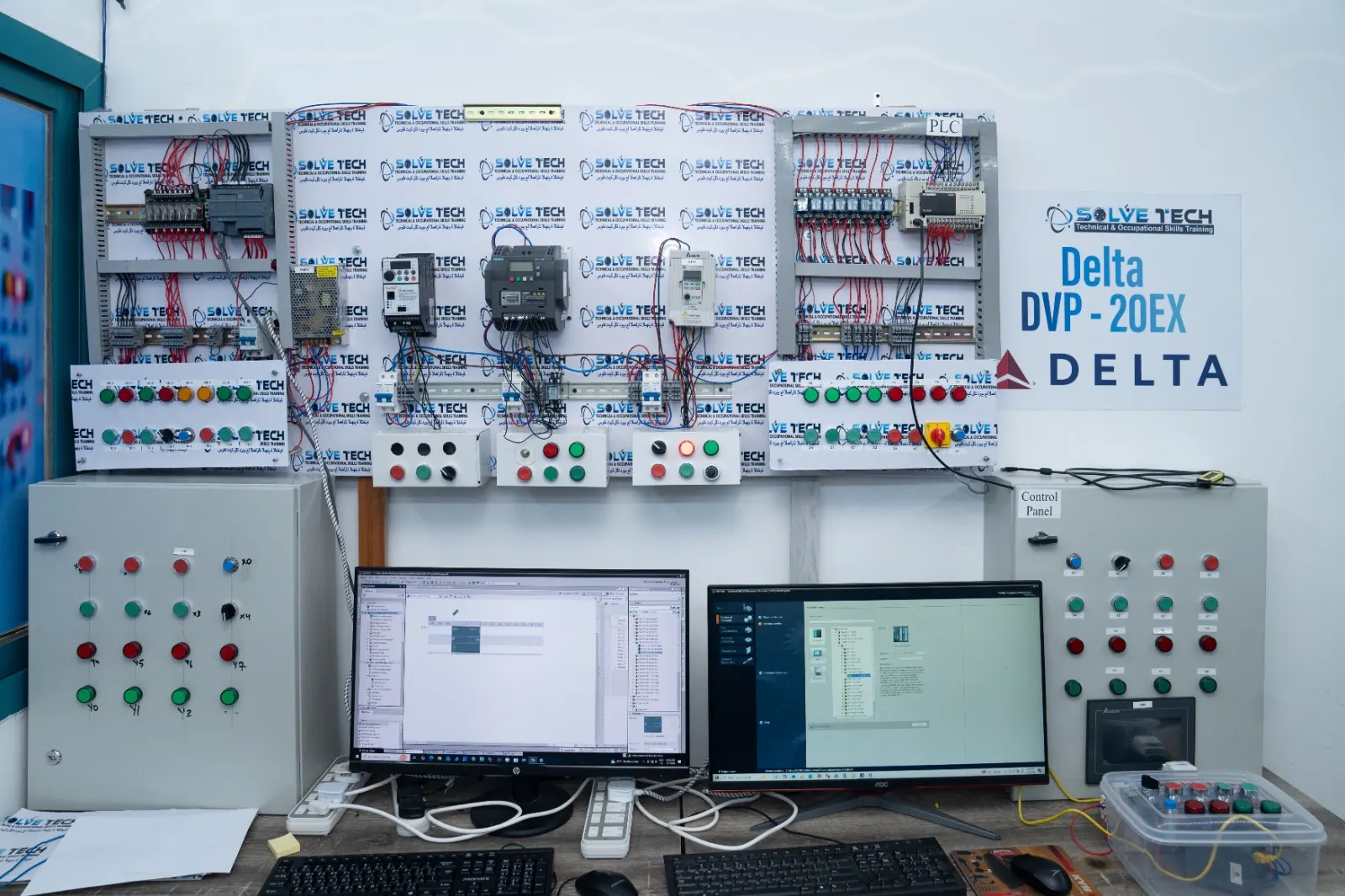
To build an automation career in the UAE, learn in this order: control wiring, PLC, HMI, drives, SCADA, then instrumentation. Each stage builds on the one before, and each maps to tasks employers hand to junior engineers.
Stage 1: control wiring
Before programming, you must be able to read a control circuit: contactors, relays, overloads, DOL and star-delta starters. Control panel design gives this base.
Stage 2: PLC
PLC programming is the core skill. Practise on real controllers, not only simulators, so that wiring faults and addressing mistakes become familiar.
Stage 3: HMI and drives
Add HMI screens so an operator can run your program, and VFD setup so you can control motor speed.
Stage 4: SCADA
SCADA connects many controllers to one control room view with alarms and history.
Stage 5: instrumentation
Instrumentation and process control covers transmitters, control valves and PID loops, which you need for process plants.
Who hires these skills
Manufacturing, water and utilities, oil and gas, building services and system integrators all use automation. A combined industrial automation course covers the first four stages in one program.
Frequently asked questions
Do I need an engineering degree for automation?
Many roles ask for a degree or diploma in electrical, electronics or instrumentation, but technicians with strong practical skills are also hired.
How long does it take to learn PLC?
Course hours vary by batch. Ask an advisor for the current duration, then plan extra practice time on top.
What comes after SCADA?
Instrumentation, industrial networking and OT cyber security.